Artists Create Works of Art Based Primarily on Cultural Traditions and Practices
The following is an initial folio plan for module 1. The outset text, earlier the colon, is the proposed folio name:
- Overview: introduction and defintions, objectives
- Introduction and definitions: intro description, opening activeness
- Basics: class and content, aesthetics, subjective and objective perspectives (one.3-1.5)
- Creative roles: artistic roles -- description, portraits, landscapes, scientific illustration, enhancing our world, narratives: how artists tell their stories, spirit/myth/fantasy (one.6-i.8)
- Artistic categories: fine art, popular civilisation, decorative arts (1.9)
- Creative styles: naturalistic, abstruse, non-objective, cultural style (1.10-1.11)
- Perception and visual awareness: perception and visual awareness (one.ten)
- Summary, activeness and assignment: (beginning at end of i.12, one.12.1-ane.12.three, 1.xiii)
Contents
- 1 Module one: Definitions, Artistic Roles, and Visual Thinking
- 1.1 Module ane Description
- 1.2 Introduction and Definitions
- 1.2.i Defining art
- i.three Form and Content
- ane.4 Aesthetics
- 1.5 Subjective and Objective Perspectives
- ane.six Artistic Roles
- one.half dozen.i Description
- 1.vi.2 Portraits
- 1.half-dozen.three Landscapes
- one.6.4 Scientific Illustration
- 1.half-dozen.five Enhancing Our World
- one.7 Narratives: How Artists Tell Their Stories
- ane.viii Spirit, Myth and Fantasy
- 1.ix Artistic Categories
- 1.9.ane Fine Fine art
- i.9.ii Popular Culture
- 1.nine.iii Decorative Arts
- i.10 Creative Styles
- 1.10.1 Naturalistic
- 1.10.2 Abstract
- 1.x.iii Non-Objective
- 1.11 Cultural Styles
- 1.12 Perception and Visual Awareness
- one.12.one Quiz
- 1.12.2 Write about it
- 1.12.3 Share information technology
- ii Assignment
- two.ane Decision
Module ane: Definitions, Creative Roles, and Visual Thinking
Attributed to Saylor.org (adjusted).
Module i Description
How would you lot define "art?" For many people, art is a specific thing: a painting, sculpture, or photograph, a dance, a poem, or a play. Fine art is uniquely human being and tied directly to culture. As an expressive medium, it allows the states to experience sublime joy, deep sorrow, confusion, and clarity. It gives vocalism to ideas and feelings, connects u.s. to the past, reflects the present, and anticipates the future. Visual art is a rich and complex subject whose definition is in flux as the civilization around it changes. This unit examines how art is defined and the different means it functions in societies and cultures.

Objectives
Upon successful completion of this unit, you will be able to:
- Ascertain 'fine art' within a cultural perspective.
- Explain the difference between 'objective' and 'subjective.'
- Explicate the different roles art plays within different cultures.
- Define the term 'subject thing.'
- Define the categories 'realistic', 'abstract,' and 'non-objective.'
- Recognize, evaluate, and describe artistic styles.
- Hash out the significant of 'aesthetics' and its relationship to cultural conventions.
- Identify and discuss issues of visual sensation.
Introduction and Definitions
This module gives a bones agreement of how art is defined and the different ways information technology functions in societies and cultures. Information technology covers the following topics:
- Form and Content
- Aesthetics
- Subjective and Objective Perspectives
- Artistic Roles
- Artistic Categories
- Cultural Styles
- Ideas of Perception and Visual Awareness
Defining fine art
How would y'all define 'art'? For many people art is a specific thing; a painting, sculpture or photograph, a dance, a poem or a play. It is all of these things, and more. They are mediums of creative expression. Webster'due south New Collegiate lexicon defines art equally "The conscious use of skill and creative imagination especially in the production of aesthetic objects." All the same fine art is much more than than a medium, or words on a page. It is the expression of our experience. Joseph Brodsky hints at a definition of art in his poem "New Life":
"Ultimately, one'due south unbound / marvel about these empty zones, / about these objectless vistas, / is what art seems to be all nearly."
Art is uniquely human and tied directly to civilization. It takes the ordinary and makes information technology extraordinary. As an expressive medium it allows us to experience sublime joy, deep sorrow, confusion and clarity. It tests our strengths, vulnerabilities and resolve. It gives vox to ideas and feelings, connects usa to the by, reflects the present and anticipates the futurity. Along these lines, fine art history, combined with anthropology and literature, are iii master sources in observing, recording and interpreting our man past. Visual art is a rich and circuitous bailiwick whose definition is in flux as the culture around it changes. Because of this, how we define art is in essence a question of agreement. In this respect, we tin can look again to the dictionary's definition for an understanding of exactly what to look for when we proclaim something every bit 'fine art'.

Activeness
Write About Information technology
Write a brief (approximately one page) response in your journal to the following questions.
- What has been your exposure to visual art?
- Has it been primarily from your family unit? School? Social activities? Personal explorations?
- Exercise yous make art? If so, what kind?
- Who is your audition?
Extend It
Optional: Please keep in heed that the grade learning objectives are simply stepping stones towards gaining a deeper personal understanding and appreciation of art. So take a moment to reflect on these questions:
- What are your own goals?
- Do y'all want to brand art? If and so, what practise you lot accept in mind?
- Would you similar to display art? If then, what are some of your ideas?
Journal your thoughts if you lot wish and refer back to them from fourth dimension to time to come across if you lot are experiencing progress in coming together your goals.
Share it
Optional: If you wish and are able, share your "Extend It" thoughts with others; e.g., other students in the the course, and invite their comments and helpful tips or experiences. Feel free to do the same for them.
Copyright: Saylor.org, under CC By License, [[1]] Unit 1
Form and Content
The ii basic considerations of art are grade : its physical and visible characteristics, and content: the meaning we derive from the work. These two terms are roped together in the climb to understand what art has to offer u.s.. As we examine art from different times, styles and cultures, the issues of form and content will employ to all of them.
2 basic considerations nosotros demand to be acquainted with are class: the physical and visible characteristics inherent in works of fine art, and content: the pregnant we derive from them. Formal distinctions include a work's size, medium (painting, cartoon, sculpture or other kind of work) and descriptions of compositional elements such as the lines, shapes and colors involved. Bug of content include whatever visual clues that provide an agreement of what the art tells the states. Sometimes an artwork's content is vague or subconscious and needs more information than is present in the work itself. Ultimately these two terms are roped together in the climb to understand what fine art has to offer us.
As we examine art from different time periods, styles and cultures, the issues of form and content volition apply to all of them. We'll explore course and content further in Modules iii and four.
Aesthetics
Aesthetics is the philosophical argument about the nature of dazzler. Information technology'southward an idea key to any exploration of art. Aesthetics deals with notions of taste, cultural conventions and the judgments nosotros make based on our perceptions.
As deep every bit visual art is embedded in the fabric of our lives, it still is the source of controversy and irony. Information technology thrives on common experience nonetheless contradicts ideas of ourselves. Art is part of the culture it'due south created in, but can reverberate many cultures at once. From where you and I stand up today fine art has become probably more complex than ever. We need a mode to access the visual information of our lodge, of past cultures, and cultures not known to u.s. to accept a manner to sympathize what we are looking at.
Subjective and Objective Perspectives
So, the first level in approaching fine art is learning to Expect at it. In hereafter discussions we will spend more time in pure observation than y'all probably have done before. Generally, we tend to look at art in terms of "liking" it FIRST, and "looking" at it later. From this perspective, the " subjective " (knowledge residing in the emotions and thoughts of the viewer) almost completely dominates our way of looking at art. In the arts, it is especially of import to begin to develop an informed or objective opinion rather than only an instinctual reaction. An objective view is one that focuses on the object's physical characteristics as the master source of data. This does non mean that you will remove or invalidate your subjective feelings near a work. In fact you will discover that the more than informed yous get, the more artwork volition affect you emotionally and intellectually. It does mean that you will larn culling ways to arroyo art, ways that allow you to find clues to pregnant and to sympathize how art reflects and affects our lives.
It'southward complex, but the satisfaction of looking at art comes from exploring the work to observe pregnant, not shying abroad from it just because we don't 'sympathise' it. Finding a definition is important because of the function art plays in societies and cultures.
Artistic Roles
Description
A traditional office of visual fine art is to describe our self and our surroundings. Some of the earliest artworks discovered are drawings and paintings of humans and wild fauna on walls deep within prehistoric caves. One detail prototype is a paw print: a universal symbol of human communication.
Portraits
Today portraits, landscapes and yet life are mutual examples of description. Portraits capture the accurateness of concrete characteristics just the very best also transfer a sense of an individual'south unique personality. For thousands of years this part was reserved for images of those in positions of power, influence and authorization. The portrait not only signifies who they are, but also solidifies class structure by presenting only the highest-ranking members of a society. The portrait bust of Egyptian Queen Nefertiti, dated to effectually 1300 BCE, exemplifies beauty and royalty. The full-length Purple Portrait of Chinese Emperor Xianfeng non only shows realism in the likeness of the emperor, information technology exults in the patterns and colors of his robe and the throne backside him.


Egyptian, Bust of Nefertiti, painted sandstone, c. 1370 BCE, Neues Museum, Berlin
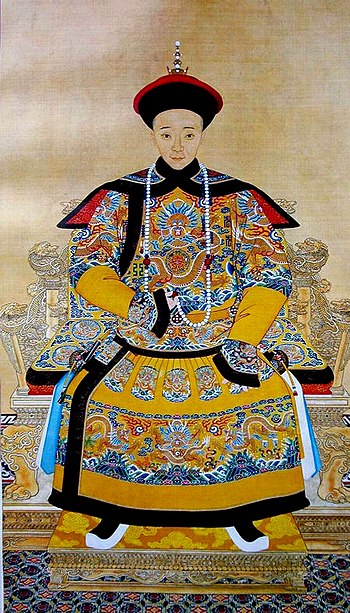
Imperial Portrait of Emperor Xianfeng, China, c. 1855. Palace Museum, Bejing
Landscapes
Landscapes – by themselves – requite us detailed data about our natural and homo fabricated environment; things like location, compages, fourth dimension of twenty-four hours, year or season plus other concrete data such as geological elements and the plants and animals inside a particular region. 'Nebamun Hunting Fowl' (below) is loaded with specific found and animate being life in Egypt'southward Nile river delta. This wall painting, dating from around 1350 BCE, shows the scribe Nebamun as he stands in a reed gunkhole near a thicket of papyrus capturing ducks. His true cat actively grabs at two birds as they try to wing away. Amongst the dissimilar species are hawks, collywobbles, herons, songbirds, and fish. The figure sitting in the boat is his daughter. The larger female figure standing at the stern is his married woman. The artist records the scene in great detail; he paints every feather on the birds, and every scale on the fish beneath the gunkhole.
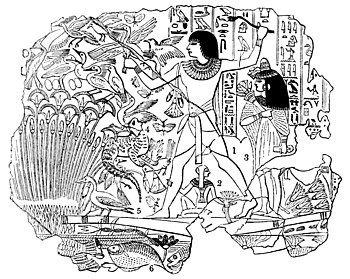
'Nebamun Hunting Fowl, Egyptian, c.1350 BCE. Fresco. British Museum, London
Scientific Illustration
Indeed, in many western cultures, the more than realistic the rendering of a scene the closer to our idea of the 'truth' information technology becomes. In the 15th century German artist Albrecht Durer creates vivid works that show a keen sense of observation. His Lobster from 1495 is uncanny in its realism and sense of animation.
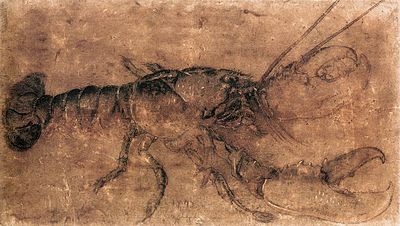
Albrecht Durer, Lobster, 1495. Staatliche Museen, Berlin
.
Out of this striving for accuracy and documentation developed the art of scientific illustration, an of import part of scientific advice earlier the advent of photography. Scientific illustrators concentrate on accuracy and utility rather than aesthetics and coment many dissimilar types of scientific phenomena.
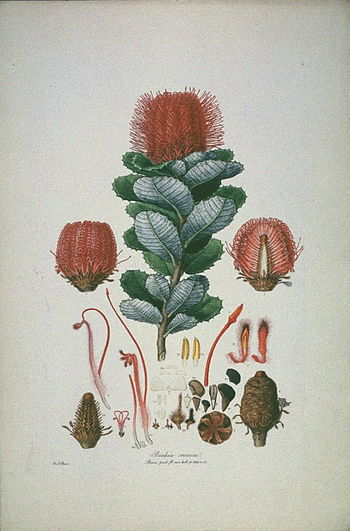
Banksiea coccinea (Illustrationes Florae Novae Hollandiae plate 3)
Enhancing Our Globe
Enhancing the world of our everyday lives is some other part art plays. This role is more commonsensical than others. It includes textiles and product blueprint, decorative embellishments to the items we apply everyday and all the aesthetic considerations that create a more comfortable, expressive environs.
Narratives: How Artists Tell Their Stories
Artists can combine representation with more circuitous elements and situational compositions to bring a narrative component into fine art. Using subject matter – the objects and figures that inhabit a work of art -- as a vehicle for communicating stories and other cultural expressions, is a traditional role of visual fine art.
The narrative tradition is strong in many cultures throughout the earth. They go a ways to perpetuate knowledge, morals and ethics, and can signify historical contexts within specific cultures. Narrative takes many forms; the spoken or written give-and-take, music, dance and visual art are the mediums most oftentimes used. Many times one is used in conjunction with another. In his Migration Series Jacob Lawrence paints stark, directly images that communicate the realities of the African American experience in their struggle to escape the repression of the South and overcome the difficulties of adjusting to the big cities in the N.
In contrast, photographers used the camera lens to document examples of segregation in the United States. Here the prototype on film tells its poignant story about inequalities based on race.
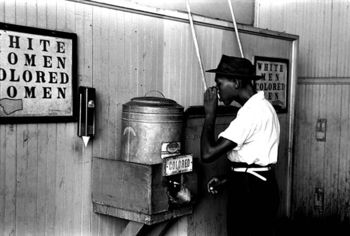
Russell Lee, Human being Drinking at a Water Libation in the Street Machine Terminal, Oklahoma Metropolis, 1939. Photo from the National Athenaeum
Spirit, Myth and Fantasy
Tied to the idea of narrative, another artistic role is the exploration of other worlds beyond our concrete one. This globe is in many ways richer than our own and includes the world of spirit, myth, fantasy and the imagination; areas particularly suited for the visual artist. Nosotros tin run into how fine art gives a rich and varied handling to these ideas. Artist Michael Spafford has spent his career presenting classical Greek myths through painting, cartoon and printmaking. His spare, abstract style uses loftier contrast images to strong dramatic upshot. A Smiling Figure from aboriginal United mexican states portrays a god of dance, music and joy. A tertiary example, Hieronymus Bosch's painting the Temptation of Saint Anthony, gives the subject matter both spiritual and bizarre significance in the style they are presented. His creative imagination takes the subject field of temptation and raises it to the realm of the fantastic. In that location is an entire module devoted to the idea of the other world later in this course.
Creative Categories
Visual arts are generally divided into categories that make distinctions based on the context of the work. For example, Leonardo da Vinci's 'Mona Lisa' would non fall into the aforementioned category as, say, a graphic poster for a rock concert. Some artworks can be placed in more than i category.
Fine Fine art
This category includes drawings, paintings, sculptures, photographs and, in the last decade, new media that are in museum collections and sold through commercial fine art galleries. Fine art has a distinction of being some of the finest examples of our man artistic heritage. Here is where you volition discover the Mona Lisa, and ancient sculpture, such as the Gandhara figure from Bharat below, and stunning ceramics from different cultures and fourth dimension periods.

Stucco Ganhara figure, India, quaternary–5th century CE. Victoria & Albert Museum, London
Popular Civilization
This category contains the many products and images nosotros are exposed to every day. In the industrialized globe, this includes posters, graffiti, advertisement, popular music, tv set and digital imagery, magazines, books and movies (every bit distinguished from picture show, which we'll examine in a different context later in the course). Besides included are cars, celebrity status and all the ideas and attitudes that help define the contemporary flow of a particular culture.
Handbills posted on telephone poles or the sides of buildings are graphic, colorful and informative, but they likewise provide a street level texture to the urban surround nigh of us alive in. Public murals serve this same function. They put an artful stamp on an otherwise bland and industrialized landscape.
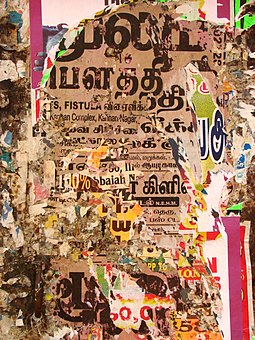
Street side handbills, Puducherry
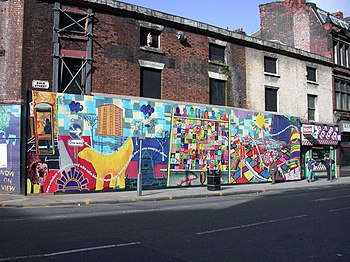
Public landscape, Liverpool
Decorative Arts
Sometimes called "crafts," this is a category of art that shows a high degree of skilled workmanship in its product. Craft works are commonly associated with utilitarian purposes, but can be aesthetic works in themselves, often highly decorated. The Mexican ceramic vessel below is an case. Handmade furniture and glassware, fine metalworking and leather appurtenances are examples of arts and crafts.
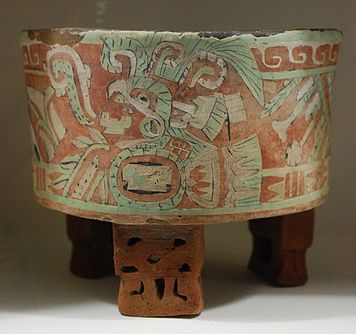
Ceramic basin, United mexican states. Engagement unknown. Painted clay. Anahuacalli Museum, Mexico City. Attributed to Alejandro Linares Garcia
.
Artistic Styles
The search for truth is non exclusive to representational fine art. From viewing many of the examples so far you can see how individual artists employ different styles to communicate their ideas. Style refers to a detail kind of appearance in works of fine art. Information technology'due south a feature of an individual creative person or a collective relationship based on an idea, civilisation or artistic movement. Following is a listing and description of the nigh common styles in art.
Naturalistic
A naturalistic way uses recognizable images with a high level of accuracy in their depiction. Naturalism also includes the idealized object: i that is modified to reach a kind of perfection within the bounds of aesthetics and form. William Sydney Mount'south painting The Bone Actor gives accuracy in its representation and a sense of character to the effigy, from his ragged-edged hat to the button missing from his belong. Mountain treats the musician'due south portrait with a sensitive mitt, more idealized by his handsome features and soft grin. Note: click the image for a larger view.
Abstract
An abstract mode is based on a recognizable object but which is and so manipulated by baloney, scale issues or other creative devices. Brainchild can exist created by exaggerating course, simplifying shapes or the employ of strong colors. Let's look at three landscapes with varying degrees of brainchild in them to meet how this style tin be so effective. In the first 1, Marsden Hartley uses abstraction to give the spare "Mural, New United mexican states" a sense of energy. Through the rounded forms and gesture in treatment nosotros can discern hills, clouds, a road and some copse or bushes.
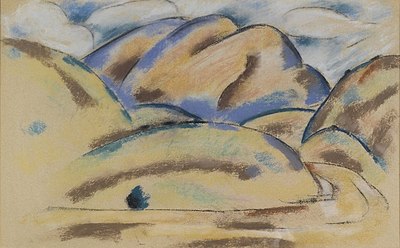
Marsden Hartley, Landscape, New Mexico, well-nigh 1916. Pastel on paper. The Brooklyn Museum, New York
Georgia O'Keeffe'due south Birch and Pino Trees -- Pink combines 'soft' and 'hard' abstraction into a tree-filled landscape dominated by a spray of orange paint suggesting a branch of birch leaves at the top left. Vasily Kandinsky's Landscape with Blood-red Spots, No. 2 goes further into abstraction, releasing color from its descriptive function and vastly simplifying forms. The rendering of a town at the lower left is reduced to blocky areas of paint and a black triangular shape of hill in the background. In all three of these, the artists manipulate and misconstrue the 'existent' mural as a vehicle for emotion.
The definition of 'abstract' is relative to cultural perspective. That is, different cultures develop traditional forms and styles of art they understand within the context of their own culture (see 'Cultural styles' below), and difficult for another culture to empathize. Then what may be 'abstract' to 1 could be more 'realistic' in style to another. For example, the Roman female bust below looks very existent from a western European artful perspective. Under the same perspective, the African mask would be chosen 'abstract'. Yet to the African civilisation that produced the mask information technology would appear more realistic.
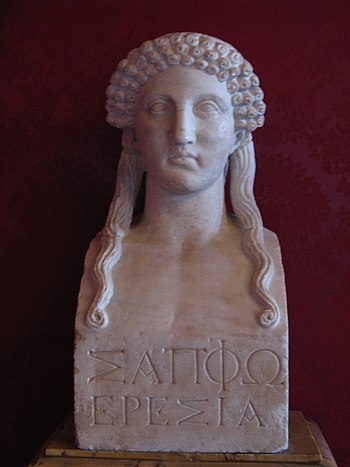
Roman bosom photo by Haklai
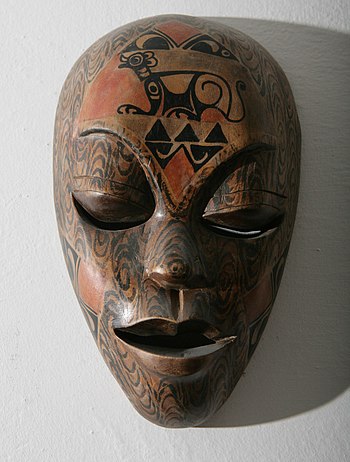
African mask photograph by Cezary
In improver, the African mask shares some formal attributes such every bit the exaggerated eyes and mouth, and the painted lines and designs found on the Tlingit 'Groundhog Mask' (below nether 'Cultural styles') from Canada's west declension. It'due south very possible these two cultures would see the Roman bosom as the 'abstract' one. And then it's of import that we sympathise artworks from cultures other than our own in the context in which they were originally created.
Questions of abstraction can likewise emerge from something as simple as our altitude from an artwork. View and read about Fanny/Fingerpainting by the artist Chuck Close. At first glance it is a highly realistic portrait of the artist's grandmother-in police. Yous tin can zoom information technology in to see how the painting dissolves into a grid of private fingerprints, a process that renders the surface very abstract. With this in listen, we can see how any work of art is essentially made of smaller abstract parts that, when seen together, brand upwardly a coherent whole.
Non-Objective
Not-objective imagery has no relation to the 'real' earth – that is – the work of art is based solely upon itself. In this way the non-objective style is completely different than abstract, and information technology's important to brand the distinction between the two. This fashion rose from the modern fine art movement in Europe, Russia and the United States during the first half of the 20th century. Pergusa Three by American creative person Frank Stella uses organic and geometric shapes and potent colour set against a heavy black background to create a vivid image. More with other styles, problems of content are associated with a non-objective work's formal structure.
Cultural Styles
Cultural styles refer to distinctive characteristics in artworks throughout a particular guild or culture. Some main elements of cultural styles are recurring motifs , created in the same mode by many artists. Cultural styles are formed over hundreds or even thousands of years and aid ascertain cultural identity. Let's discover evidence of this style by comparison ii masks; one from Alaska and the other from Canada. The Yup'ik trip the light fantastic toe mask from Alaska is quite stylized with oval and rounded forms divided by broad bands in strong relief. The painted areas outline or follow shapes. Carved and attached objects give an upward motility to the whole mask and the face carries an blithe expression.
By comparison, a 'Groundhog Mask' from the Tlingit culture in coastal northwestern Canada exhibits similar forms and many of the same motifs. The two mouths are particularly like to each other. Groundhog'south visage takes on human – like characteristics but as the Yup'ik mask takes the form of a bird. This cultural style ranges from western Alaska to northern Canada.
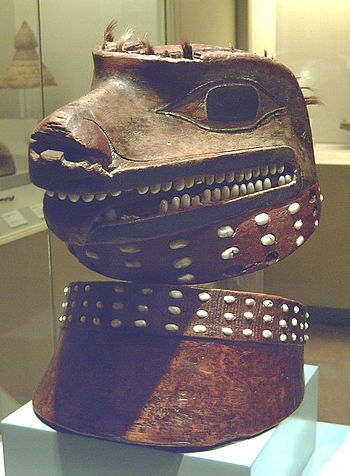
Tlingit, Ground Hog Mask, c. 19th century. Carved and painted wood, animal hair. Collection the Burke Museum, University of Washington, Seattle. Used by permission.
Celtic fine art from Great Great britain and Ireland shows a cultural fashion that's been identified for thousands of years. Its highly refined organic motifs include spirals, found forms and zoomorphism. Intricate and decorative, the Celtic mode adjusted to include early volume illustration. The Book of Kells is considered the pinnacle of this cultural style.

Page from the Volume of Kells, around 800 CE. Trinity Higher, Dublin
Perception and Visual Awareness
Visual information – images from media and the environment around united states of america – dominates our perception. Our optics literally navigate united states through a visual landscape all our lives, and nosotros all make decisions based on how and what we see. Separating the subjective and objective ways we see helps us get more visually enlightened of our surroundings. Scientifically, the process of seeing is the upshot of light passing through the lens in our eye, so concentrating it on the retina at the back of the eye. The retina has nerve cells that human activity like sponges, soaking up the data and sending it to the visual cortex of our brain. Hither the calorie-free is converted to an image that we tin can perceive – the 'truth' – as we sympathize information technology to exist. We are exposed to and then much visual information every day, peculiarly with the advent of mass media, that information technology's hard to process all of it into specific meaning. Beingness visually aware is more complicated than just the concrete act of seeing considering our perceptions are influenced by exterior factors, including our own prejudices, desires and ideas nigh what the 'truth' really is. Moreover, cultural ties to perception are many. For example, let's look at three images that share one particular element; that of raised arms, and see how nosotros perceive each one co-ordinate to what we know about them.
Art is a resource for questioning our perceptions about how objects and ideas present themselves. The Belgian artist Rene Magritte used his easel as a soapbox to confront the viewer with confounding visual information. Click the hyperlink to picket a short video where Magritte considers language and perception.
hither is a difference between looking and seeing. To await is to glance back and along, enlightened of surface qualities in the things that come up into our line of sight. To encounter is more most comprehending. After all, when we say "I run across" we actually mean that nosotros sympathize. Seeing goes beyond appearances. Then, as we face up the huge amounts of visual information coming at us nosotros start to make choices about what nosotros keep and what we edit out. We concentrate on that which has the most meaning for u.s.a.: a street sign that helps us become home, a view of the mountains that lets us enjoy a part of nature's spectacle, or the computer screen that allows the states to gather information, whether it's reading the content in this course or communicable upwards on the 24-hour interval's news or emails. Our gaze becomes more than specific, and with that comes specific meaning. At this point what we run into becomes part of what we know. It's when we cease to contemplate what we run across – the view of the mountain mentioned above, a portrait or simple visual composition that catches our eye – that we make reference to an aesthetic perception . That is, when something is considered for its visual properties alone, and their relation to our ideas of what is beautiful, as a vehicle for meaning.
No thing how visually aware we are, visual clues solitary hinder our power to fully comprehend what nosotros see. Words, either spoken or read as text, help fill in the blanks to understanding. They provide a context , a historical background, religious function or other cultural significance to the art we are looking at. We ask others for data, or find information technology ourselves, to help understand the meaning. In a museum or gallery it may exist wall text that provides this link, or a source text, website or someone knowledgeable about the fine art.
Now that nosotros have a bones agreement of:
- what art is,
- the cultural roles it plays, and
- the dissimilar categories and styles,
we tin now begin to explore more specific concrete and conceptual issues surrounding it in the side by side module. Before we do this however, this is time to consummate a quiz and some other learning activities.
Activity
Quiz
Complete the following auto-marker quiz. If at that place are areas where you encountered difficulties, this is a proficient time to undertake a review.
QUIZ HERE
Write about information technology
In your journal answer to the following questions:
- Do you lot concur with the definition for "art" as it is explained in this module? Why or why not?
- Can you add to the definition?
- Is your definition coming from a subjective or objective perspective? Explain your thinking.
Optional: If yous wish and are able, share your "Write about Ii thoughts with others; e.g., other students in the the class, and invite their comments and helpful tips or experiences. Feel free to do the same for them.

Consignment
- Answer to the following questions in your journal. Your response should be at to the lowest degree 200 words.
- How would you lot depict the work? What medium is used?
- What artistic role does it play within the culture it was created?
- Does information technology take on more than one role? How?
2. Creative styles alter over time and throughout cultures, yet some forms are repeated despite the changes. We tin can examine these forms to aid in finding the meaning, or content, in them. View the three works of art from the hyperlinks below. They are all from different time periods and cultures. Notice how each ane has a repeated formal chemical element like to the others. In your journal write at least one paragraph to explain each work of fine art. Your response should be at least 200 words.
- What mode and category does each work belong to?
- Do these similarities have ties to a common meaning between all of them, or do you call back the meaning for each work is separate from the others? Why or why not?
- What cultural, religious or other considerations do you take into account in defining your answers?
Hither are the images to view:
- Totem Pole
- Giotto Crucifix
- Minoan Snake Goddess
Decision
You have now reached the end of Module ane.Earlier you go on to the side by side module, make sure you have completed the activities and assignments. If you take been able to communicate with others, share ideas and suggestions, and communicate with an teacher if available, all the better. Expect dorsum at your personal goals in the "Extend information technology" section. If your studies through this module inspired ideas that can enhance your achievement of your goals, please make a annotation of them in your periodical.
dingeraffiriplent.blogspot.com
Source: https://wikieducator.org/Art_Appreciation_and_Techniques/Definitions,_Artistic_Roles_and_Visual_Thinking
0 Response to "Artists Create Works of Art Based Primarily on Cultural Traditions and Practices"
إرسال تعليق